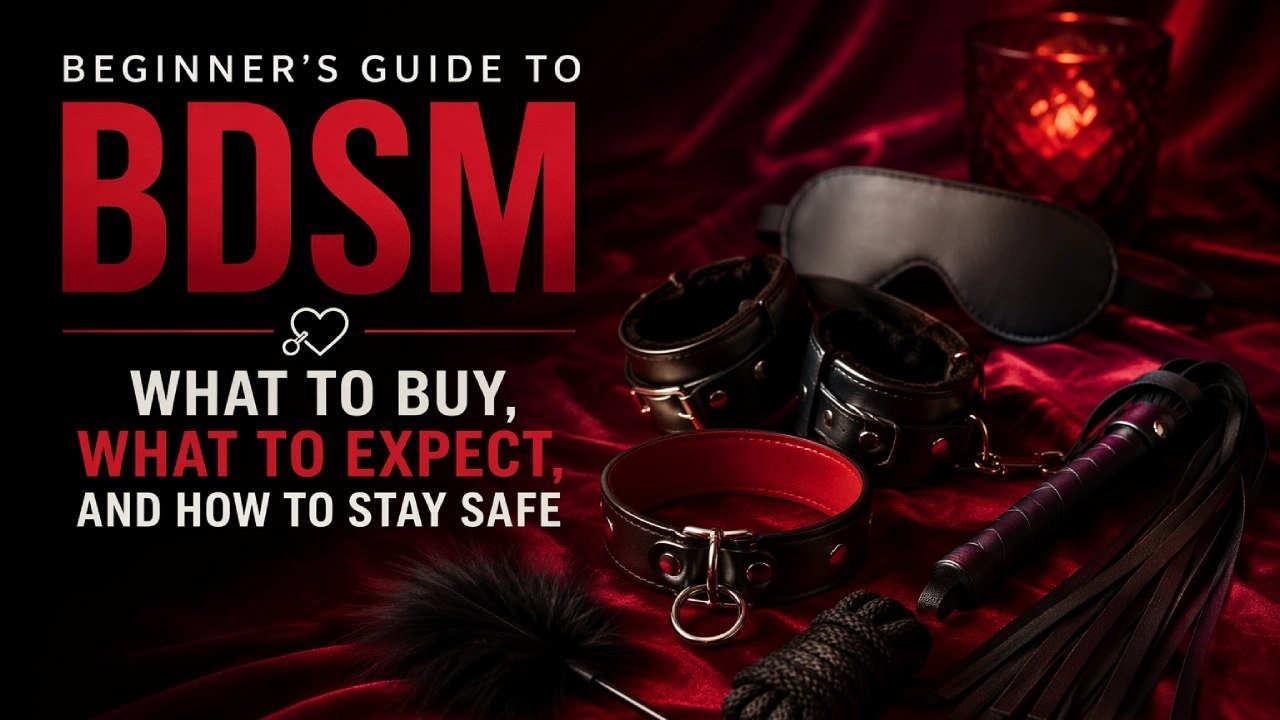
BDSM is one of the most searched topics in the adult space — and also one of the most misunderstood. Movies and TV shows have painted an extreme picture that leaves most curious people thinking it’s either too intense or too complicated for them. The reality? Most people who explore BDSM start small, keep it playful, and find that it adds a whole new dimension of trust and connection to their relationship.
This guide is for complete beginners. We’ll explain what BDSM actually means, cover the most important safety rules, tell you exactly what to buy first, and walk you through how to have your first experience without the stress. By the end, you’ll have everything you need to start — confidently and safely.
Table of Contents
- What is BDSM, really?
- The golden rules: consent, safewords, and safety
- Understanding roles: Dom, Sub, and Switch
- What to buy first as a beginner
- ToyDare starter picks
- Tips for your first BDSM experience
- Common beginner mistakes to avoid
- Frequently asked questions
What Is BDSM, Really?
BDSM is an umbrella term that covers a wide spectrum of consensual intimate practices. The acronym actually stands for multiple overlapping concepts:
- B&D — Bondage & Discipline
- D&S — Dominance & Submission
- S&M — Sadism & Masochism
You don’t have to engage in all of these — or even most of them. Many couples start simply with light bondage (tying hands, using a blindfold) and never go further, and that still counts. BDSM is a spectrum. You get to decide exactly where on that spectrum you want to explore.
At its heart, BDSM is about consensual power exchange — one partner takes a leading role (dominant) and the other takes a receiving role (submissive), with both people enthusiastically agreeing to that dynamic. The key word is consensual. Everything in BDSM that is done safely and ethically is built on mutual agreement and ongoing communication.
Why do people enjoy it? The reasons are varied: heightened sensation, deeper trust, the thrill of surrendering or taking control, novelty, and the psychological intimacy that comes from being completely vulnerable with a partner you trust. Research has consistently shown that people who practice BDSM report high levels of relationship satisfaction and communication — likely because it requires communication to work well.
The Golden Rules: Consent, Safewords, and Safety
Before anything else — before buying a single toy or trying a single thing — you need to understand these three fundamentals. They are non-negotiable in any BDSM dynamic.
1. Consent is everything
Every activity must be explicitly agreed to by both partners beforehand. This is often done through a process called negotiation — a conversation (or series of conversations) where both partners discuss what they’re interested in, what they’re curious about, and what is completely off the table. This isn’t awkward formality; it’s actually a deeply intimate conversation that many couples say brings them closer together.
A useful framework is SSC (Safe, Sane, Consensual) — all activities should be physically safe, done with a clear and sober mind, and fully agreed upon. Some people use RACK (Risk-Aware Consensual Kink), which acknowledges that some activities carry inherent risk but that informed consent is the standard.
2. Set a safeword
A safeword is a word or signal that immediately stops all activity — no questions, no hesitation. The most common system is the traffic light system:
- Green — everything is great, keep going
- Yellow — slow down, check in, I need a moment
- Red — stop everything immediately
For situations where speaking might be difficult (e.g. during bondage), a physical signal works just as well — holding a small object that can be dropped, or tapping three times on your partner’s arm.
3. Aftercare is not optional
Aftercare is the time spent reconnecting and caring for each other after a BDSM session. It might look like cuddling, talking, having a snack, wrapping up in a blanket, or whatever makes both partners feel safe and grounded. The intensity of a BDSM scene — even a mild one — can trigger an emotional release, and aftercare helps both partners transition back to normal headspace. Skipping aftercare is one of the most common beginner mistakes.
4. Physical safety basics
- Never restrict airways or apply pressure to the neck
- When using restraints, always be able to free your partner quickly — keep safety scissors or a key nearby at all times
- Check in regularly during any scene, especially with restraints
- Never engage in BDSM under the influence of alcohol or substances — judgment is impaired
- Start lighter than you think you need to — you can always escalate; you can’t un-do something that caused pain or distress
Understanding Roles: Dom, Sub, and Switch
BDSM dynamics typically involve two roles:
The Dominant (Dom/Domme) — the partner who takes the leading, controlling role. Contrary to popular belief, the Dominant is not the person “in power” in the traditional sense. They are responsible for their partner’s safety, comfort, and experience. Many experienced BDSM practitioners say the Dominant carries the greater responsibility in a scene.
The Submissive (Sub) — the partner who gives up control within the agreed boundaries. Submission is a choice and an act of trust. “The sub holds the real power” is a common saying in BDSM communities — because they set the limits and can end the scene at any time with a safeword.
Switch — someone who enjoys both roles at different times, with different partners, or even within the same session. Many beginners find they’re naturally drawn to one role, but it’s completely fine to enjoy both.
There’s no pressure to pick a permanent role. Try both, explore what resonates, and let it evolve naturally.
What to Buy First as a Beginner
The number one beginner mistake is buying too much too fast. Start with two or three items that introduce the concept of BDSM — restraint, sensory deprivation, and light discipline — without overwhelming either partner. Here’s a logical progression:
Step 1: Sensory deprivation — a blindfold
A blindfold is the single most beginner-friendly BDSM item you can buy. Removing sight instantly heightens every other sense — touch, sound, anticipation — and creates an immediate sense of vulnerability without any physical restraint. It’s also reversible in a second. This is the perfect first step.
Step 2: Light restraints — soft cuffs or a bondage kit
Once you’ve tried a blindfold and enjoyed it, soft restraints are the natural next step. Look for cuffs with Velcro or quick-release clasps for your first experience — these allow instant removal and don’t require a key or complicated knots. If you want to go slightly further, a beginner bondage kit will bundle a blindfold, wrist cuffs, ankle cuffs, and often additional accessories together.
Important: For your first time, always position restraints where the submissive can be freed in under 5 seconds. Practice the release mechanism before you start.
Step 3: Metal restraints for more intensity
Once you’re comfortable with soft restraints and know what you enjoy, you might want to upgrade to something with more weight and psychological intensity. Steel handcuffs deliver exactly that — they feel more “real,” are more restrictive, and create a different psychological dynamic. Always ensure they come with keys and that both partners know where the key is at all times.
Step 4: Add a bondage kit for a full experience
A complete bondage kit gives you everything in one package — blindfold, wrist and ankle cuffs, cross straps, and more. These are ideal for couples who’ve already tried individual items and want to expand their options without buying everything separately.
What about floggers, paddles, or wax?
These fall into the Sensation Play and S&M categories. They’re absolutely valid to explore, but we recommend saving them until after you’ve established a solid foundation with restraints and communication. Sensation play requires more knowledge about impact and physical limits — that’s a great topic for an intermediate guide once you’ve mastered the basics.
ToyDare Starter Picks
Best first purchase: Bondage Fantasy Kit for Couples
The Bondage Fantasy Kit from ToyDare is an ideal all-in-one starting point for couples. It includes everything you need to begin exploring bondage and restraint play without having to buy pieces separately. The components are beginner-friendly, the materials are body-safe, and the kit covers both sensory deprivation and restraint — the two most popular entry points into BDSM. This is the one to buy if you want to try it without overthinking it.
Best for sensory play + restraint combo: 6-Piece Bondage Kit (Blindfold + Cross Strap)
The 6-Piece Bondage Kit gives you more variety and flexibility. With a blindfold, cross strap, and multiple cuffs, this kit lets you experiment with different restraint positions and levels of restriction. The six-piece format means you won’t quickly outgrow it — there are enough combinations to keep things interesting well past the beginner stage. Great value for couples who know they want to explore further.
Best for intensity upgrade: Steel BDSM Handcuffs with Keys
Once you’ve tried soft restraints and want more psychological weight to the experience, the Steel BDSM Handcuffs are the step up. Metal cuffs feel completely different from fabric ones — heavier, more restrictive, more deliberate. They come with keys (keep one accessible at all times), and the solid steel construction means they’ll last indefinitely. These are best for couples who are already comfortable with bondage basics and are ready to escalate intensity.
Recommended pairing: BerryLube Water-Based Lubricant
While not a BDSM item specifically, keeping BerryLube on hand is always a good idea for any intimate session — BDSM or otherwise. Available in unflavored, strawberry, and coffee aroma variants.
Tips for Your First BDSM Experience
Have the conversation before, not during. Talk about what you both want to try, what you definitely don’t want, and agree on a safeword before you even start. Trying to negotiate limits mid-scene is both awkward and ineffective.
Start much lighter than you think you need to. First-timers consistently report that things feel more intense in the moment than they anticipated. What seems mild in your imagination can feel quite powerful when you’re actually restrained or blindfolded. Start at 20% of what you think you want and work up from there.
Keep it short for your first session. Twenty to thirty minutes is plenty for a first experience. You’re learning how both of you respond — physically and emotionally — and a shorter session lets you process the experience and talk about it before diving deeper.
Check in frequently. As the Dominant, check in verbally throughout the session — “how are you doing?”, “is this okay?”, “do you want me to continue?” This isn’t a mood-killer; it’s the foundation of trust that makes the experience feel safe for the submissive.
Don’t skip aftercare. After any BDSM experience, even a mild one, spend time reconnecting. Ask each other what you enjoyed, what felt unexpectedly intense, and what you’d want to try again or do differently. This debrief is where real intimacy deepens.
Try both roles before deciding you have a preference. Many people discover that what they imagined they’d enjoy isn’t actually what they respond to most. Give both sides a genuine try before settling into a dynamic.
Common Beginner Mistakes to Avoid
Buying too much too fast. A full dungeon kit on your first order is overwhelming and usually wasteful. Start with one or two items, learn what you actually enjoy, and expand from there deliberately.
Skipping the conversation. Assuming your partner is on the same page without actually talking about it is how people end up having a bad experience. The pre-scene conversation isn’t optional — it’s what makes everything else enjoyable.
Not having a safeword. Even if you think you won’t need it, set one. Knowing it exists removes anxiety for both partners and actually makes the submissive feel safer, which paradoxically allows them to let go more fully.
Choosing metal restraints for your very first time. Metal handcuffs are wonderful — but for a complete first-timer, they’re harder to remove quickly and can feel more overwhelming than you’re ready for. Start with soft cuffs or a fabric bondage kit, then graduate to metal once you know you enjoy restraint play.
Ignoring aftercare. Especially for the submissive partner, skipping aftercare can lead to a phenomenon called “sub drop” — a sudden emotional low that can happen hours or even a day after an intense session. Proper aftercare mitigates this significantly.
Comparing your experience to fiction. What you see in movies or read in novels is dramatized for entertainment, not accuracy. Real BDSM between real people is messier, funnier, more communicative, and ultimately more intimate than any fictional portrayal.
Frequently Asked Questions
Is BDSM safe?
Yes — when practiced with informed consent, clear communication, and proper safety precautions, BDSM is safe. The risks come from skipping safety protocols: not setting safewords, using restraints incorrectly, or engaging without explicit consent. Follow the guidelines in this post and you’re in good shape.
Do I need experience to try BDSM?
No experience is necessary. Everyone starts somewhere. The only prerequisites are a willing partner, an honest conversation about what you both want to try, and an agreed safeword. Start with the simplest items (a blindfold, soft cuffs) and build from there at whatever pace feels comfortable.
What’s the difference between a bondage kit and buying handcuffs separately?
A bondage kit bundles multiple items together — usually a blindfold, wrist restraints, ankle restraints, and sometimes additional accessories — at a better value than buying separately. Handcuffs alone address only wrist restraint. A kit gives you more options for your first experience and is usually the better starting point for couples who want to explore different types of restraint.
Can BDSM be one-sided — what if only one partner is interested?
This is a very common situation. If one partner is curious and the other is hesitant, the best approach is patience and conversation — never pressure. Share what draws you to it, listen to your partner’s concerns, and consider starting with something extremely mild (like a blindfold during sex) rather than jumping to restraints. Many people who were initially hesitant find they enjoy sensory play once they’ve actually tried it in a low-pressure context.
How do I know if BDSM is right for me?
The honest answer is: you often don’t know until you try it. Curiosity is enough of a reason to explore. Start small, communicate openly with your partner, and pay attention to how you both feel during and after. BDSM isn’t for everyone — and that’s perfectly fine. But plenty of people who thought it wasn’t for them were surprised once they actually gave it a fair, well-prepared try.
What’s the most beginner-friendly BDSM item to start with?
A blindfold is universally the most beginner-friendly starting point. It introduces sensory deprivation with zero risk of physical discomfort, is instantly reversible, requires no special knowledge to use, and immediately heightens intimacy. From there, soft wrist cuffs are the logical second step — and ToyDare’s Bondage Fantasy Kit combines both in one package.
The Bottom Line
BDSM doesn’t have to be complicated, extreme, or intimidating. At its core, it’s about consensual exploration, deep trust, and heightened sensation — and that’s accessible to anyone willing to communicate openly with their partner.
Start with a conversation. Set a safeword. Pick one or two beginner-friendly items. Go slowly. Do aftercare. And most importantly — have fun with it. The couples who get the most out of BDSM are the ones who treat it as a collaborative adventure rather than a performance.
If you have questions about any of the products or need help deciding what to start with, drop them in the comments below. And if you’re ready to take the first step, browse ToyDare’s bondage collection below.
Shop ToyDare’s BDSM starter collection:
→ Bondage Fantasy Kit for Couples
→ 6-Piece Bondage Kit (Blindfold + Cross Strap)
→ Steel BDSM Handcuffs with Keys
→ BerryLube Water-Based Lubricant